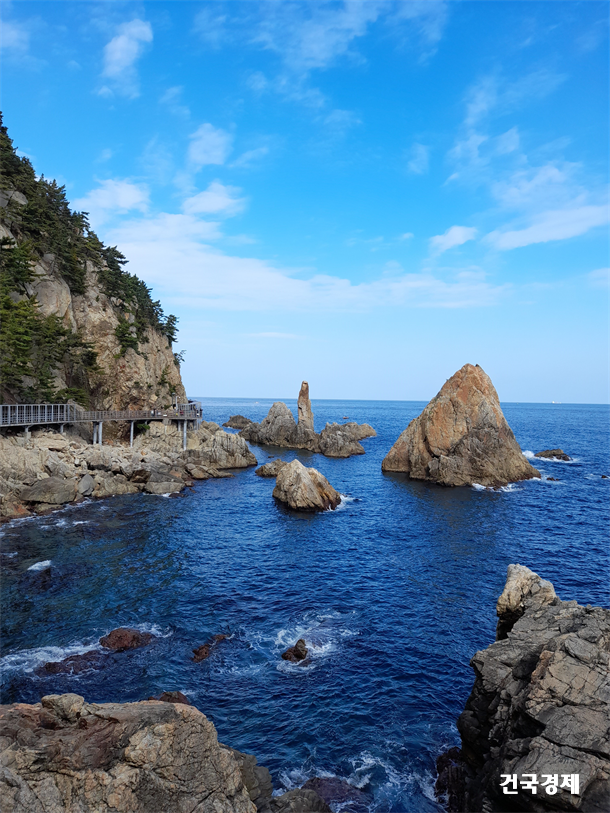
청옥 같은 동해...
History of Gangwon-do
A province located in the mid-eastern part of the Korean Peninsula, Gangwon-do features roughly a four-sided plain with a larger north-south than east-west portion. It is bordered by the East Sea to the east, Gyeongsangbuk-do to the south, Chungcheongbuk-do to the southwest, Gyeonggi-do to the west, Hwanghae-do to the northwest and, finally, Hamgyeongnam-do to the north. The province is surrounded by high mountains and deep valleys formed by the Taebaek Mountains running north to south on the peninsula. About 82% of the province is comprised of mountainous areas. Gangwon-do spouts the headwaters of the three longest rivers in South Korea,: Namhan River, Bukhan River and Nakdong River. The area also provides Korea's most scenic mountains, such as Geumgang Mountain, Seorak Mountain, Odae Mountain, Taebaek Mountain and Chiak Mountain.
The rich natural wealth of today's Gangwon-do attracted human settlements in Korea's earliest history and gradually formed a tribal state called Yaemaek when Korea was in the Gojoseon Period (2333 BCE - 108 CE). The area was briefly under the influence of Baekje, during the Three Kingdoms Period (c. 1st c. BCE - 668), when the kingdoms established a centralized authoritarian rule to effectively control their regional areas.
It was then ruled by Goguryeo, between the 3rd and 5th centuries, when the kingdom reached the zenith of its power. It was next ruled, from the 6th century, by Silla when it emerged a major power on the peninsula. It was in 685, the 5th year of the Silla King Sinmun's reign, when Silla established the Nine Provinces (Ju) in an effort to ensure the effective rule of its territory. This followed its dramatic expansion with the unification of the Three Kingdoms, when Gangwon-do began to appear in Korean history as an administrative subdivision with clearly defined geographical borders.
The Nine Provinces of Unified Silla are Sakju, Myeongju, Hanju, Ungju, Sangju, Jeonju, Muju, Gangju and Yangju. Today's Gangwon-do then consisted of two provinces, Sakju which corresponds mostly to today's Yeongseo region and Myeongju which corresponds to today's Yeongdong region. These were then subdivided into 21 counties (Gun) and 51 prefectures (Hyeon). A special administrative unit called Bugwongyeong ("Northern Region Capital") was in the jurisdiction of Sakju. The counties and prefectures under the Unified Silla's two provinces, Sakju and Myeongju, are shown in Table 1 below.
- 자료/Gangwon-do

 가장많이 본 기사
 홈 >
외국어뉴스 > 영어권뉴스
홈 >
외국어뉴스 > 영어권뉴스







 :
: 
